
Dental labs today are expected to deliver restorations that look more natural while maintaining fast turnaround times and consistent production quality. Traditional monochrome zirconia still offers good strength, but many technicians spend additional time on staining, layering, and characterization to achieve acceptable anterior aesthetics.
As cosmetic dentistry continues growing, more laboratories are moving toward multilayer zirconia materials that provide built-in shade transition and natural translucency directly from the disc.
For labs handling both anterior and posterior restorations, consistency has become just as important as strength. Choosing the right multilayer zirconia supplier now directly affects workflow efficiency, remake rates, and restoration quality.
WHITETH developed the SHT-ML zirconia series specifically for modern CAD/CAM workflows, helping laboratories reduce manual finishing while improving aesthetic predictability.
Built for Natural-Looking Restorations
One of the biggest limitations of traditional zirconia materials is their flat and opaque appearance. Although they are durable, they often require additional porcelain layering or manual staining to create a natural effect.
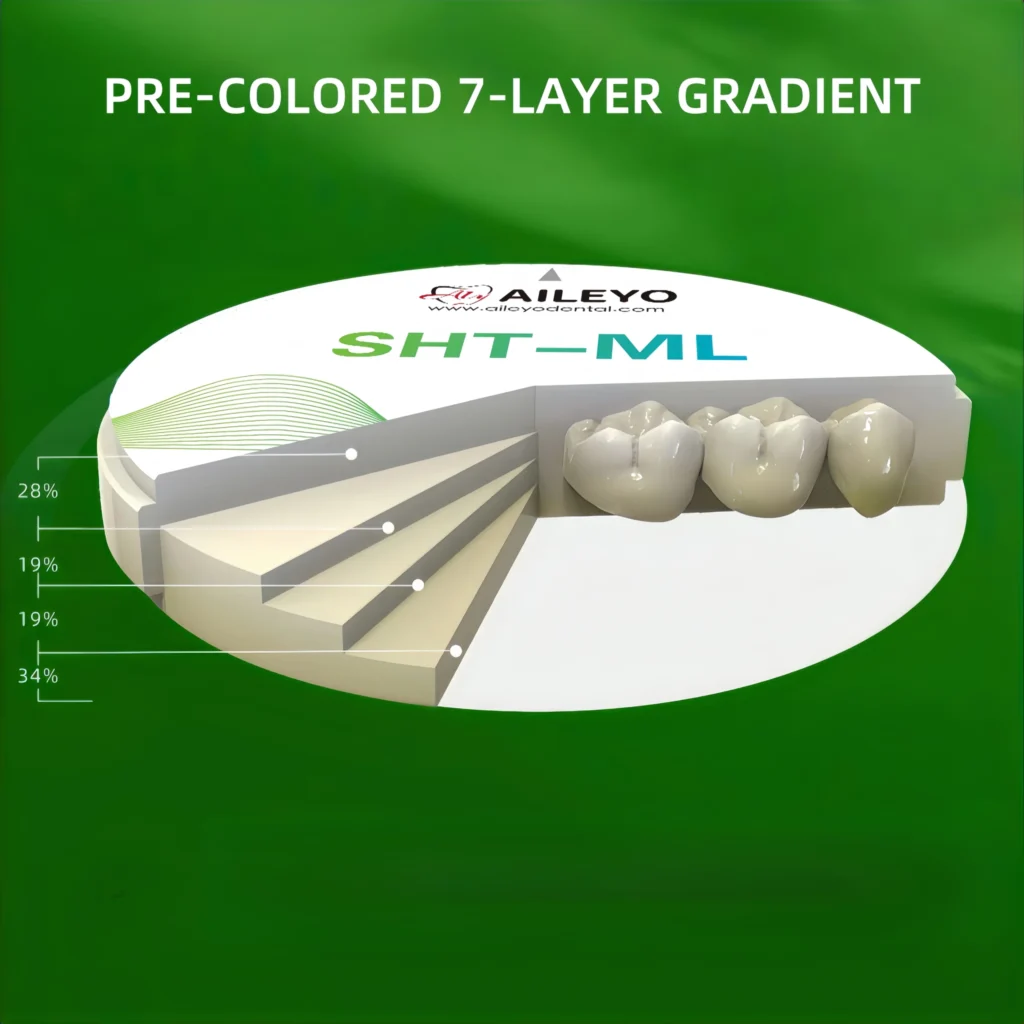
SHT-ML is designed to solve this problem through a seamless multilayer structure that closely mimics the natural transition between dentin and enamel.
Key Aesthetic Advantages
- Seamless 7-layer gradient structure
- Natural shade transition from cervical to incisal area
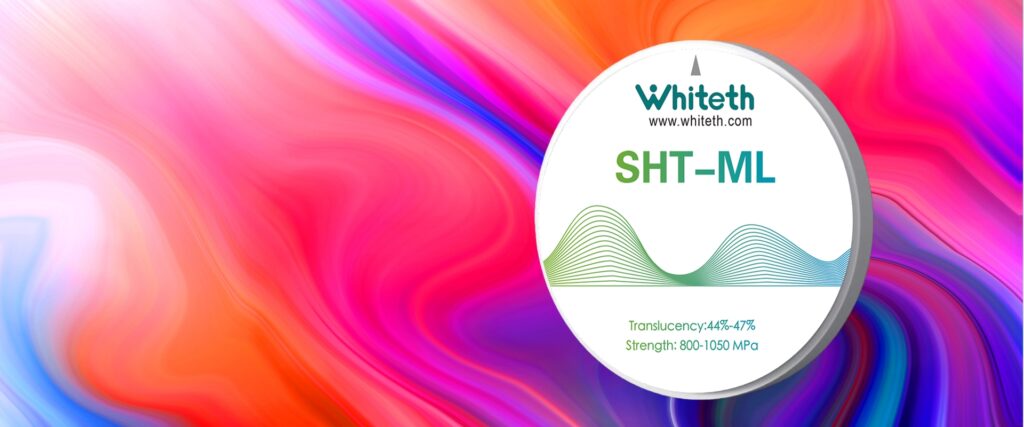
- 44%–47% translucency for lifelike appearance
- Pre-shaded multilayer design
- Reduced manual staining and coloring
- Improved consistency between restorations
For technicians, this means less chairside adjustment and fewer aesthetic corrections after sintering.
For clinics, it means restorations that appear more natural under different lighting conditions.
Balancing Aesthetics and Strength
Many zirconia materials focus heavily on either translucency or strength, forcing laboratories to choose between appearance and durability.
SHT-ML is designed to balance both.
With flexural strength ranging from 800 MPa to 1050 MPa, the material supports a wide range of clinical indications without sacrificing aesthetics.
Suitable Applications
- Anterior crowns
- Posterior crowns
- Bridges
- Veneers
- Inlays and onlays
- Full contour restorations
- Implant-supported restorations
The higher cervical strength supports posterior durability, while the more translucent incisal area improves anterior appearance.
This combination helps laboratories simplify material inventory while maintaining flexibility across different restoration types.
Why Labs Are Replacing Monochrome Zirconia
Many dental technicians still use monochrome zirconia because of its familiarity and structural reliability. However, traditional zirconia workflows often increase labor costs and production time.
Technicians typically need to:
- Apply additional staining liquids
- Perform manual characterization
- Adjust shade inconsistencies
- Spend more time on finishing
Multilayer zirconia reduces these extra steps.
Workflow Comparison
| Laboratory Concern | Traditional Zirconia | WHITETH SHT-ML |
|---|---|---|
| Shade transition | Artificial appearance | Natural multilayer gradient |
| Manual staining | Frequently required | Greatly reduced |
| Finishing workload | Higher | Lower |
| Aesthetic consistency | Variable | More stable |
| Production efficiency | Slower | Faster |
| Restoration versatility | Limited aesthetics | Anterior + posterior |
For high-volume laboratories, reducing manual finishing can significantly improve overall productivity.
Designed for Efficient CAD/CAM Workflows
Modern dental labs depend on repeatable workflows and predictable milling behavior. Materials that shrink inconsistently during sintering often lead to poor marginal fit and costly remakes.
SHT-ML is engineered for stable CAD/CAM processing from milling to final sintering.
Stable Sintering Performance
Each disc is manufactured under controlled production conditions to maintain consistent density and shrinkage behavior.
Recommended sintering temperature:
- Recommended: 1500°C
- Sintering range: 1500°C–1530°C
This stable thermal behavior helps technicians achieve reliable fit and accurate dimensions after sintering.
Reduced Technician Dependency
The pre-shaded multilayer structure also helps laboratories standardize production quality across different technicians.
Instead of relying heavily on individual staining techniques, labs can produce more consistent restorations directly from the disc.
This becomes especially valuable for growing laboratories managing larger daily case volumes.
Compatible With Mainstream Milling Systems
Laboratories often hesitate to change zirconia suppliers because of compatibility concerns.
WHITETH SHT-ML is designed for broad compatibility with major CAD/CAM systems used globally.
Supported Systems
- Roland
- Amann Girrbach
- Zirkonzahn
- Wieland
- Imes-Icore
- Open 98mm systems
Available Thicknesses
- 10mm
- 12mm
- 14mm
- 16mm
- 18mm
- 20mm
- 22mm
- 25mm
Shade Options
- Full VITA 16 shades
- Bleach shades OM1, OM2, OM3
This flexibility helps distributors and laboratories simplify purchasing while covering different clinical requirements.
Physical Properties That Support Long-Term Reliability
Dental laboratories increasingly evaluate zirconia materials based on measurable physical performance instead of marketing claims alone.
SHT-ML provides stable physical characteristics suitable for long-term clinical applications.
Material Specifications
- Density after sintering: 6.09±0.01 g/cm³
- Fracture toughness: 5.3–6.3 MPa·m¹ᐟ²
- Chemical solubility: <100 μg/cm²
- Monoclinic phase after aging: <5%
- Radioactivity: <0.1 Bq/g
These values help support durability, structural stability, and long-term clinical safety.
Benefits for Distributors and Dental Laboratories
Choosing a reliable multilayer zirconia supplier affects more than restoration appearance. It also impacts workflow stability, production cost, and long-term customer satisfaction.
For Dental Laboratories
- Reduce manual staining time
- Improve shade consistency
- Lower remake rates
- Increase production efficiency
- Simplify technician workflows
For Dental Clinics
- Achieve more natural restorations
- Improve patient satisfaction
- Reduce turnaround time
- Maintain reliable restoration strength
For Distributors
- Stable batch consistency
- OEM and private label support
- Competitive global market demand
- Broad CAD/CAM compatibility
- Reliable long-term cooperation
Why WHITETH Focuses on Workflow Consistency
WHITETH works closely with dental laboratories and distributors to understand real production challenges inside modern CAD/CAM environments.
Instead of focusing only on specifications, the company prioritizes:
- Stable production quality
- Consistent multilayer transition
- Reliable milling performance
- Predictable sintering behavior
- Long-term distributor support
This workflow-centered approach helps laboratories improve operational efficiency while maintaining restoration quality.
Conclusion
As cosmetic dentistry and digital workflows continue expanding, multilayer zirconia materials are becoming the preferred choice for modern dental laboratories. Labs today need materials that reduce manual finishing, improve aesthetic consistency, and maintain reliable structural performance across different restoration types.
WHITETH SHT-ML combines natural multilayer aesthetics, 44%–47% translucency, stable flexural strength, and CAD/CAM workflow compatibility in a single solution. For laboratories, distributors, and clinics searching for a dependable multilayer zirconia supplier, SHT-ML offers a practical balance of efficiency, durability, and natural-looking results for modern digital dentistry.